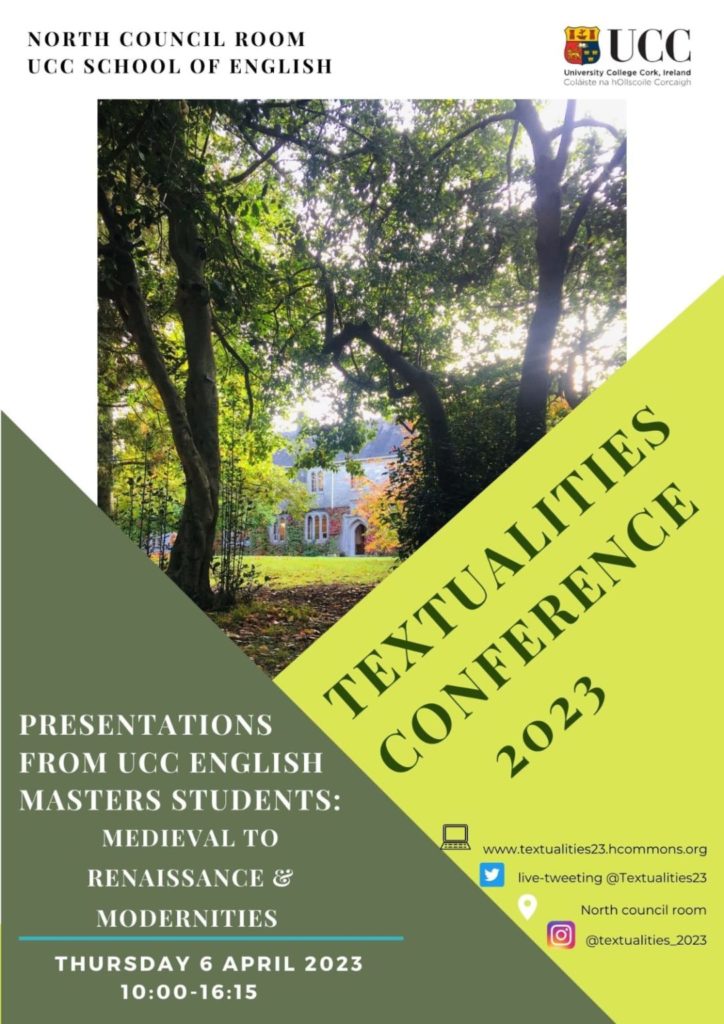
Welcome once more, good folk, to the Textualities ’23 blog, home of all your favourite Textualities ’23-themed interviews! Speaking of which…
Q: Hello, and thanks for talking to us today! I know things are getting busy as we approach D-Day. Would you please introduce yourself and tell us where you’ve studied before?
My name is Yuk Yin Chan, and I’m an MA student studying MedRen at UCC. I also studied my BA here, a joint degree in English and Psychology. Oh, and please, call me Yue. Everyone does!
Q: Can do, Yue! So, where do your literary interests lie?
Predominantly in gender studies and feminist criticism. I realise as I say this aloud that it’s a perhaps a little nerdy, but I actually enjoy reading philosophy feminist criticism in my spare time! Classic 20th -century writers like Simone du Beauvoir as well as modern ones like Camille Paglia. Even radical writers like Andrea Dworkin, who is rather intense to put it mildly, can yield fascinating ideas or generate interesting thoughts. I don’t agree with everything they say, of course, but still; it’s a stimulating subject.
Q: And do you find it overlaps much with your medieval reading?
Very much so, yes. There’s a barrier of experience between men and women that always manifests when one writes about other. Besides the medieval greats like Chaucer and the Gawain poet, female writers like Margery Kempe and Julian of Norwich are the ever-so-distant forerunners of the feminist writers I mentioned before.
Q: Will you presenting something related to medievalist gender studies for the conference?
Yes, I will. I’ll be examining gender, space, and place in Chaucer’s Troilus and Criseyde. In particular, there seems to be a real split between public, masculine-dominated spaces and private spaces in which femininity is ‘allowed’, even on the part of male characters like Troilus. For instance, in the act of transition from the parade ground to his private chambers, Troilus reveals feminine qualities that seem completely absent in public.
Q: Fascinating stuff! Shall we call it there? And if anyone reading wants to hear more, come check out a truly egalitarian public space on April 6th at Textualities ’23!